

There’s no doubt that, in Japanese motor sport, one name stands out among the rest. In almost everything they do, they need to be on top. The fastest, the most advanced. HKS will stop at nothing to collect these titles, and the TRB-03 has become their newest vessel to achieve them. The company has enveloped it’s priority in the project with the goal of being nothing less than the fastest around Tsukuba’s TC2000. It was even re-branded as the ‘Tsukuba Record Breaker’, from it’s original designation as the GTS800; a tip of the hat to it’s capped power level (which is debatable…). The car has been through extensive testing over the past year, and last weekend at HKS Day, I was able to finally get a closer look at it.

I’m a pretty big fan of the underdog when it comes to motor sport. It even pains me to think that HKS can hit the now coveted 49 mark before Under Suzuki. I would be naive though, if I didn’t recognize that as a very real possibility. The simple truth of the matter is that HKS is in a much better financial situation to be funding such a project. Keep in mind, HKS is much more than a tuning company; they are a global powerhouse in the automotive and transport industry with nearly 140 million USD in business capitol. They produce ISO9001 quality OEM parts for various manufactures, provide Bi-fuel and CNG solutions for logistics companies, produce LS Aviation prop engines, as well as their world-wide parts distribution. Not that they’re working with unlimited money, as I’m sure they have a budget too, but to achieve an unofficial lap time of 50.259 in just under a year and very little time on track is a testament of both their mechanical prowess, and their ability to afford the time in which it takes to do so. With ‘NOB’ Taniguchi behind the wheel, and the most advanced aerodynamics and mechanics in play, it’s no wonder HKS has gotten to where they currently are so fast.
In hindsight, it’s an incredible testament to Under’s driving ability. His S15, while equal in power (give or take), is sporting somewhat old aero. While Andrew Brilliant of AMB designed both kits being used, the technology and knowledge of aerodynamics on these types of applications has advanced so quickly that the Silvia’s aero is rather outdated. Remember it was designed back in late 2015. The ‘Infinity Wing’, pioneered by Andrew, that is sported on the HKS car is an entirely new step deeper into the field. For whatever reason, HKS opted to remove the Infinity Wing from the car for the Fuji exhibition laps, opting instead for a rather crude reiteration of side splitters. When I posted the video on our Instagram, a few users responded by saying that they changed it to better suit the front straight. Whatever the case, Andrew Brilliant had mentioned that it did more harm than good, and that the car suffered from increased drag, and that Taniguchi mentioned the car was understeering much more than normal.

The intense amount of downforce that these aero kits are making puts a very increased amount of stress on the tires causing much greater deformation than normal conditions. All of a sudden, vertical and lateral sidewall deflection solely due to aerodynamic grip becomes a factor. S-type tires weren’t necessarily designed with these stresses in mind, and as you’ll see shortly in our coverage, or may have already seen from other sources, this very topic became an issue for Garage G-Force at HKS Day when they suffered a burst tire towards the end of the main straight. Initial speculation was that the shear speed the EVO achieved, due in part to Fuji Speedways lengthy front straight, increased the downforce that the Voltex kit made enough to push the body into the tire shredding it. Some cited too soft of springs, despite them running somewhere in the range of a 38k-42k weight front spring. What actually seemed to have occurred though, was that the downward force generated at those speeds simply was too much for the tire to withstand. If that truly was the case, then what HKS had reasoned initially isn’t really up for debate, and actually was great planning on their part. Tsukuba’s straight is much shorter however, and whether or not the TRB-03 can achieve that kind of downforce at a much lower rate of speed has yet to be seen.
My personal guess? It’s not an issue at TC2000, and they are simply using a faster tire to hit their mark first. Although my friend Amemiya disagrees with me…do conspiracy theories in time attack exist? Is this the first? I suppose while we’re on the topic, I don’t think the engine is capped at 800ps either…


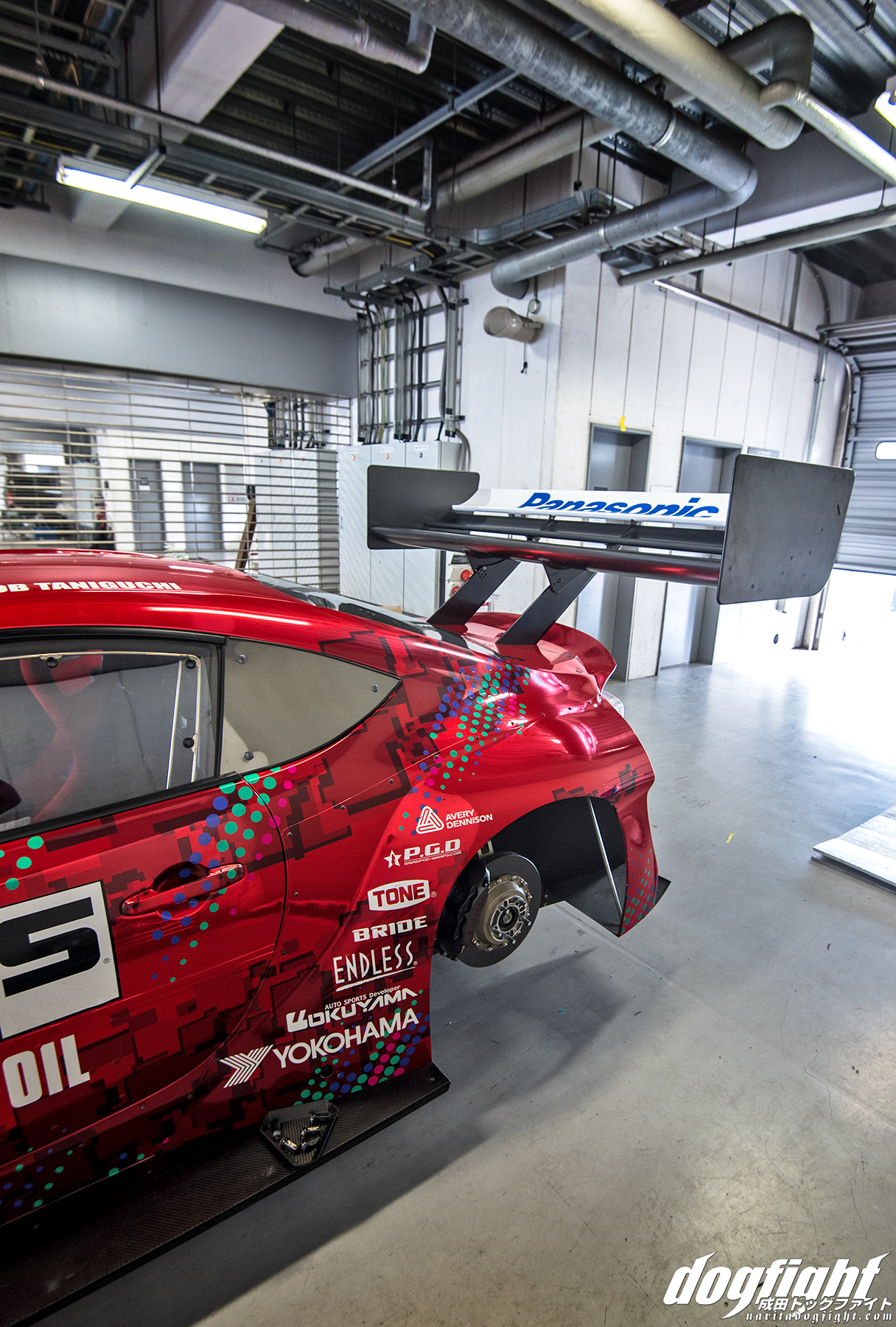


The suspension arms are custom all around, but the rear suspension is not what you’d typically find in the back of an 86, as the chassis has been totally modified to accommodate the aero. I don’t have specifics, but there are other benefits of having suspensions mounted as such. I’m not sure if this was the sole reason, or if they are gaining benefits similar to a push/pull rod setup with the strut being away from airflow.


